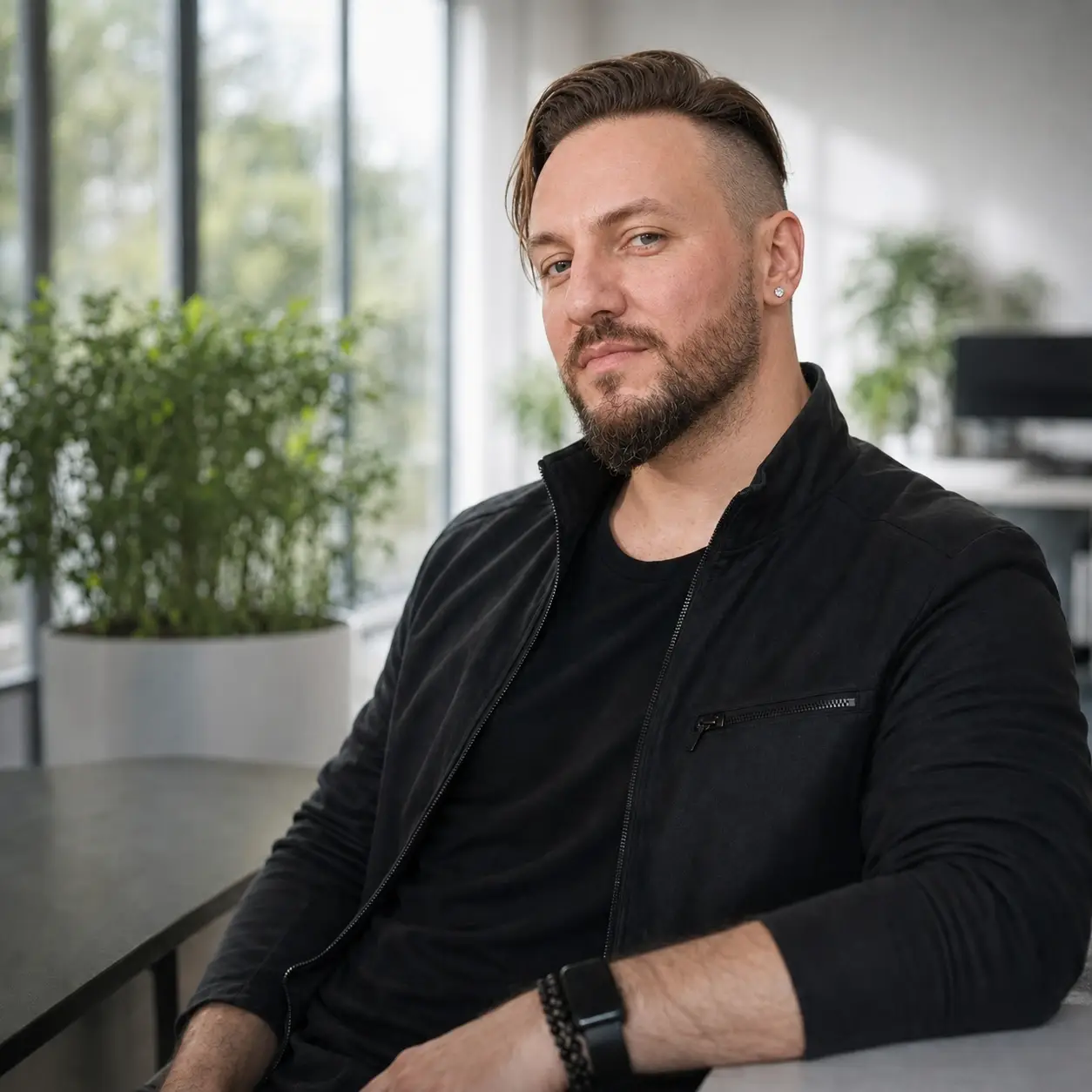
I am Uğur Akçıl - a software engineer who has been building systems for 21 years, and an engineering executive whose perspective was forged inside production environments, one incident at a time.
My career did not start in strategy decks. It started in 2005, writing code for enterprise web projects (Casio, Koton) at my first job, and almost immediately running my own freelance venture, Kandela Web, on the side. Every layer of seniority since has been earned on the same surface: real systems, real users, real failure modes, real consequences.
That origin still defines how I lead.
How the Trajectory Unfolded
The arc is not theoretical. Each phase taught something specific.
2005-2008 - Production from day one. Early enterprise work at Yedi24 on full-stack implementations for known brands, then Kandela Web as my first founded venture. Built systems with limited tooling, under freelance and small-team constraints. This is where system intuition is formed: by shipping things that have to actually work.
2008-2013 - Backend depth and the first teaching role. Senior backend developer at media-focused agencies (Reklamred, MediaClick). Enterprise CRM systems, integration discipline, working closely with non-technical stakeholders on user-centric platforms for large clients. Alongside this, in 2010, I taught software and design foundations at Mikrosis - my first teaching role, and the start of an instinct I never lost: translating complex technical reality into something a team can actually apply.
2013-2019 - Founder-CTO era. Co-founded Elif Web Studio (2013-2014) and ORZED (2013-2019), where I designed and launched a cryptocurrency trading platform with full blockchain integration, built the secure payment and transaction systems behind it, and owned the technical roadmap from zero to production. Held CTO at Wiiraa Bilişim (2015-2016), where systematized delivery pipelines, custom internal tooling, and reusable component frameworks lifted engineering efficiency by roughly 270 percent. This is where I learned what architectural decisions cost at the company level - decisions you cannot quietly walk back.
2019-2020 - Technical management under pressure. Technical Manager at Extratik, leading VOIP platform development and resolving critical performance bottlenecks and security vulnerabilities in legacy systems under tight delivery deadlines, with zero tolerance for downtime.
2020-Present - Director of Software Engineering at Digital Exchange. Six years leading architecture and development of scalable systems serving multiple enterprise clients. Multi-language stacks (Go, Python, Node.js), CI/CD pipelines for production delivery, AI-assisted data processing and automation pipelines integrated into real production workflows, security and reliability standards across cloud and Linux-based environments. Owning the architecture, scalability, and risk decisions for the engineering organization.
Engineering Depth, Executive Perspective
At each step, the role demanded both - and I built both deliberately.
Most engineering executives drift toward abstraction over time. The hands stop touching the systems, meetings replace code, and the gap between what they recommend and what production actually requires becomes a quiet liability.
I operate the other way. The technical literacy stays current: deployment pipelines, infrastructure tradeoffs, performance failure modes, the actual behavior of distributed systems under load. The executive perspective comes from having repeatedly owned the downstream consequences of technology decisions: budget, team, timeline, risk, customer trust.
Both layers feed each other. The outcome is decisions that are structurally sound, not cosmetically impressive.
The AI-Era Thesis
AI is not a feature. It is a structural shift in how software is built and how engineering teams operate.
Most companies treat AI adoption as a tooling project. They install assistants, evaluate models, run pilots, and produce demos. Then production reality arrives: cost overruns, fragmented workflows, ambiguous code review, unclear ownership between humans and agents, quality regressions, no measurable productivity gain.
The failure is not at the model layer. It is at the management layer.
AI-assisted development, in practice, is a new management discipline. It changes how teams plan work, how tasks get distributed between humans and agents, how code is reviewed, how quality is preserved at higher velocity, and how individual developer roles are redefined. The organizations that get this wrong are paying for AI without capturing its leverage.
This is where most of my advisory time goes today.
Decision Philosophy
Technology decisions are rarely reversible.
I do not optimize for the most exciting choice in the room. I optimize for the choice that survives the next two years:
- Technical feasibility under actual constraints, not idealized ones
- Operational sustainability over multi-year horizons
- Financial consequence at production scale
- Long-term architectural integrity
- The organization's real capability to operate what gets built
Once a direction is defined, it has been pressure-tested against complexity and risk before I commit. Then the commitment is complete.
Clarity precedes execution. Structure precedes speed.
What Advisory Engagement Looks Like
Engagements typically fall along three dimensions, often overlapping.
Managerial advisory. Engineering organization design, role definitions, review and release practices, team scaling, and how leadership itself needs to be restructured for AI-native workflows.
Production advisory. Architecture decisions, platform reliability, AI integration into production pipelines, performance and security baselines, infrastructure economics.
Educational advisory. Structured training programs for engineering teams adopting AI-assisted development, internal enablement materials, and technical curricula that turn AI fluency from individual skill into organizational capability.
The educational layer is not an afterthought. The teaching instinct started in 2010 at Mikrosis and has shaped my engineering work as much as my advisory work. The technical content and training material being published on this site is the natural continuation of that thread - the same translation work, in a more durable medium.
When Organizations Reach Out
The patterns I see most often:
- Growth has exposed architectural weaknesses the original design did not anticipate
- AI adoption is producing demos but not measurable productivity, and leadership cannot see why
- Engineering teams are mid-restructure and the new ways of working are not converging
- A major technology decision is on the table and the cost of getting it wrong is too high to default to the loudest voice in the room
- Production reliability has eroded and the team is firefighting rather than building
These are the moments where disciplined judgment matters more than enthusiasm.
Closing
I build foundations.
Foundations that hold under traffic, complexity, and team growth. Foundations that turn AI from a cost center into leverage. Foundations that outlive the engagement they were defined in.
That is the standard I work to.